A Timeline of DeltaQuad: From an Attic Workshop to a Team of 80
:format(webp):no_upscale())
DeltaQuad’s journey began with one question and grew from an attic-built prototype into a team of 80 developing professional VTOL UAV systems.
18 June 2026
DeltaQuad began with a real-world problem that needed a solution, not with a finished aircraft.
At that time, most drones could only stay in the air for a few minutes, making them hard to use for surveying, inspection, or mapping. We started looking for a better way.
The idea was simple: combine the efficiency of a fixed-wing aircraft with the flexibility of vertical take-off and landing. Some doubted it would work, but we built it and tested it ourselves.
We moved forward one flight at a time. Each test brought a new challenge, and every rebuild was a chance to fix it. Endurance, payload, stability and control became the focus of each new test flight and design revision.
What started as an experiment soon became our way of working. We build carefully, test thoroughly, learn from each result and keep improving the design. This approach shaped our first aircraft, the next platform and eventually the company we now call DeltaQuad.
The first builds
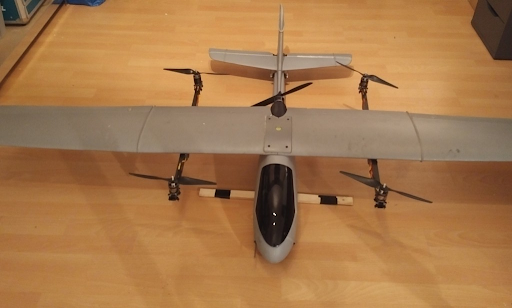
In 2014, we built our first proof-of-concept: the QuadRanger, a hybrid fixed-wing VTOL aircraft. We published the build log online while looking for an airframe better suited to professional use.
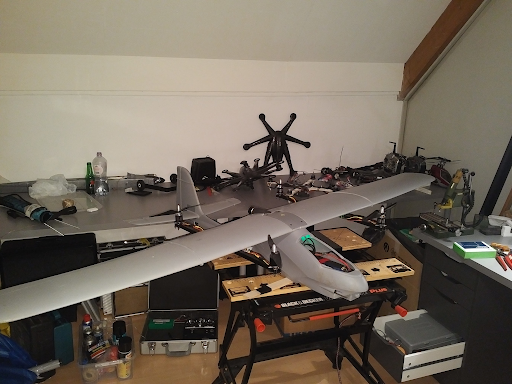
In 2015, we built and flew our first aircraft from a small attic workshop. Our team also created its own autopilot and tested it in real flights. We used open-source technologies and got support from a community of developers and enthusiasts who helped us improve our ideas and software. Most importantly, we proved we could build both the aircraft and its control systems ourselves.
By 2016, our flight experience helped us set clear goals. We focused on endurance, payload capacity and air stability, using the Skywalker X8 as our first test platform as the DeltaQuad Pro began to take shape.
First stable flights
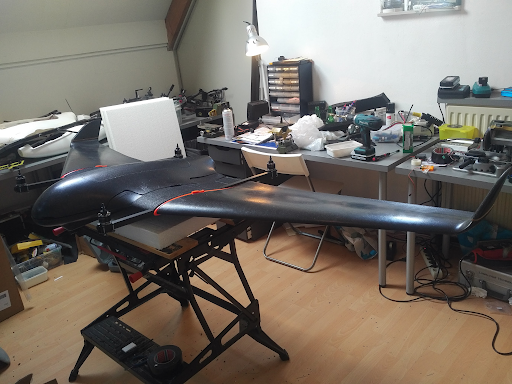
By 2017, the aircraft was flying stable GPS-guided routes. The pilot could still take control when needed, but flights were becoming easier to repeat. The aircraft also collected raw sensor and flight data, giving the team reliable results to compare after each test.
It was also the year the company publicly took shape. The first name and logo were introduced, with Droneslab used for custom work and Vertical Technologies for hardware sales. Later, the first DeltaQuad Pro was sold to a customer in South Korea.
In 2018, our team moved into a bigger workshop and office in Badhoevedorp. The new space helped us work more efficiently, build more aircraft and get ready to grow beyond the original team. That year, we also received our first military orders from the UK Ministry of Defence.
Growing into DeltaQuad
By 2019, the core team had grown to four employees and interns, and the company was still called Vertical Technologies. We introduced a new logo to show that the business was becoming more focused and ambitious.
The next big step came in 2020 with Evo. After years of flight experience, Evo offered longer endurance, higher payload capacity, better stability, lower noise, retractable landing gear, fewer parts and faster setup. Its first test flights met and even beat our early performance goals.
In 2021, DeltaQuad became both our main aircraft platform and our company name. The name comes from the idea that started everything: a delta wing combined with a quadcopter setup. The platform kept improving through real-world use, customer feedback and updates to its modular payload and avionics systems. Around this period, the H16 ground control interface also introduced built-in joysticks for ISR camera control and manual input, supporting aircraft designed to fly autonomously by default.
Production, capability and scale
In 2022, DeltaQuad PRO remained in industrial production as a long-range professional platform. A growing user base and large customer orders drove a major production phase, including the shipment of PRO systems to Ukraine. At the same time, Evo entered its first prototype trials and early testing in Ukraine.
In 2023, DeltaQuad moved into a new facility in Duivendrecht as the team grew to 20 people. That same year, a partnership with YellowScan resulted in a fully integrated LiDAR-RGB system.
The following year brought several major developments. DeltaQuad achieved ISO 9001 certification and delivered 150 Evo aircraft and 75 trackers under a production order. Visual navigation also replaced GPS-based navigation, reducing reliance on satellite positioning.
Where we are now
In 2025, DeltaQuad set new records in long-endurance flights and partnered with Tulip Tech to improve energy performance. By then, the team had grown to 75 people, and the company had become a larger defence-focused organisation.
Today, DeltaQuad is home to around 80 people and continues to grow. What began with a single aircraft has developed into a company that designs, manufactures and supports UAV systems for customers around the world.
Over the years, the aircraft have been upgraded, the facilities have expanded, and the team has grown from two people to dozens of engineers, operators, manufacturing specialists and support staff. Yet the approach remains much the same as it was in the beginning: build carefully, test thoroughly, learn from the results and keep improving.
From the first proof-of-concept aircraft in 2014 to industrial production, ISO 9001 certification, visual navigation technology and record-setting endurance flights, each step has built on the one before it.
The question that started the journey still guides us today. How can we build aircraft that fly farther, perform better and solve real operational challenges? Every new aircraft, every new capability and every new team member helps us answer it.