DeltaQuad Brings Shipboard Landing Challenge to TU Delft
:format(webp):no_upscale())
DeltaQuad challenged students at TU Delft to tackle one of maritime UAV operations’ toughest control problems: landing a VTOL drone on a moving ship deck.
18 June 2026
Landing a drone on solid ground is already a complex task. Landing a vertical take-off and landing (VTOL) drone on a moving ship while accounting for wind, waves, sensor uncertainty and changing deck position introduces a very different level of complexity.
That was the challenge DeltaQuad brought to students at the Control Robotics Fair at TU Delft.
During the workshop, titled “Landing on a Moving Target: Shipboard Landing VTOL Control with the DeltaQuad Evo,” students were invited to think through one of the most demanding problems in maritime UAV operations: how to safely land a VTOL aircraft on a moving ship deck.
For DeltaQuad, the workshop was a way to bring a real-world autonomy challenge into an academic setting. Shipboard landing brings together aircraft design, control systems, sensor fusion, environmental disturbances and real-time decision-making. It is not a theoretical exercise. It is the kind of applied autonomy problem that has to work in the real world.
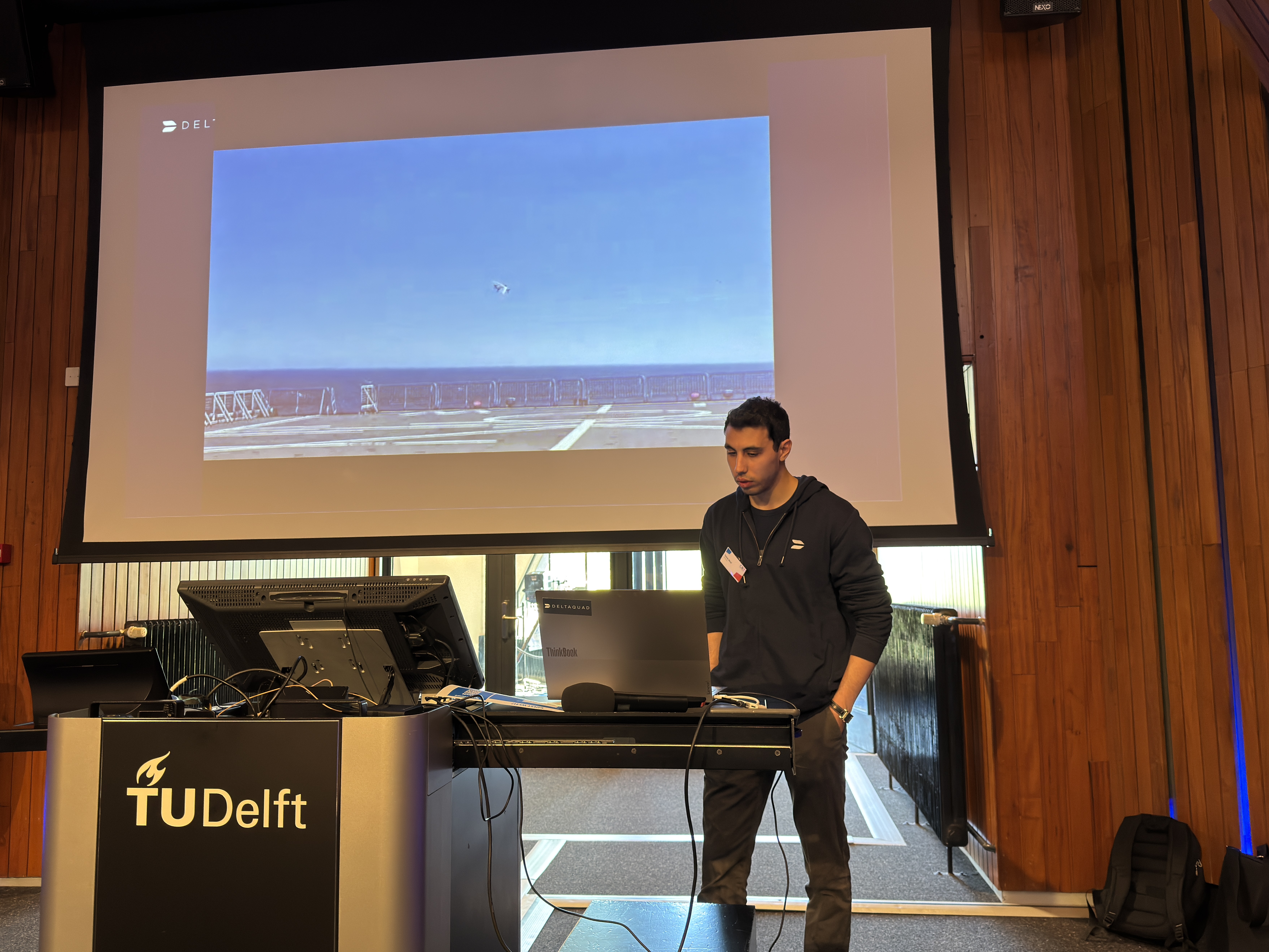
The workshop used the DeltaQuad Evo as the reference platform
The session began with an introduction to the DeltaQuad Evo and the engineering principles behind its design.
Students were introduced to the aircraft’s VTOL architecture, fixed-wing flight capabilities, transition behaviour, aerodynamic trade-offs and control considerations. This gave them the technical context needed to understand why shipboard landing is not simply a matter of descending onto a target.
In a maritime environment, the target is never truly still. The ship may be moving horizontally, the deck may be rising and falling with the waves, the wind can change quickly and sensor data may be affected by the surrounding environment. For a VTOL aircraft, transitioning between fixed-wing and multicopter flight adds another layer of control complexity.
Breaking the challenge into real engineering problems
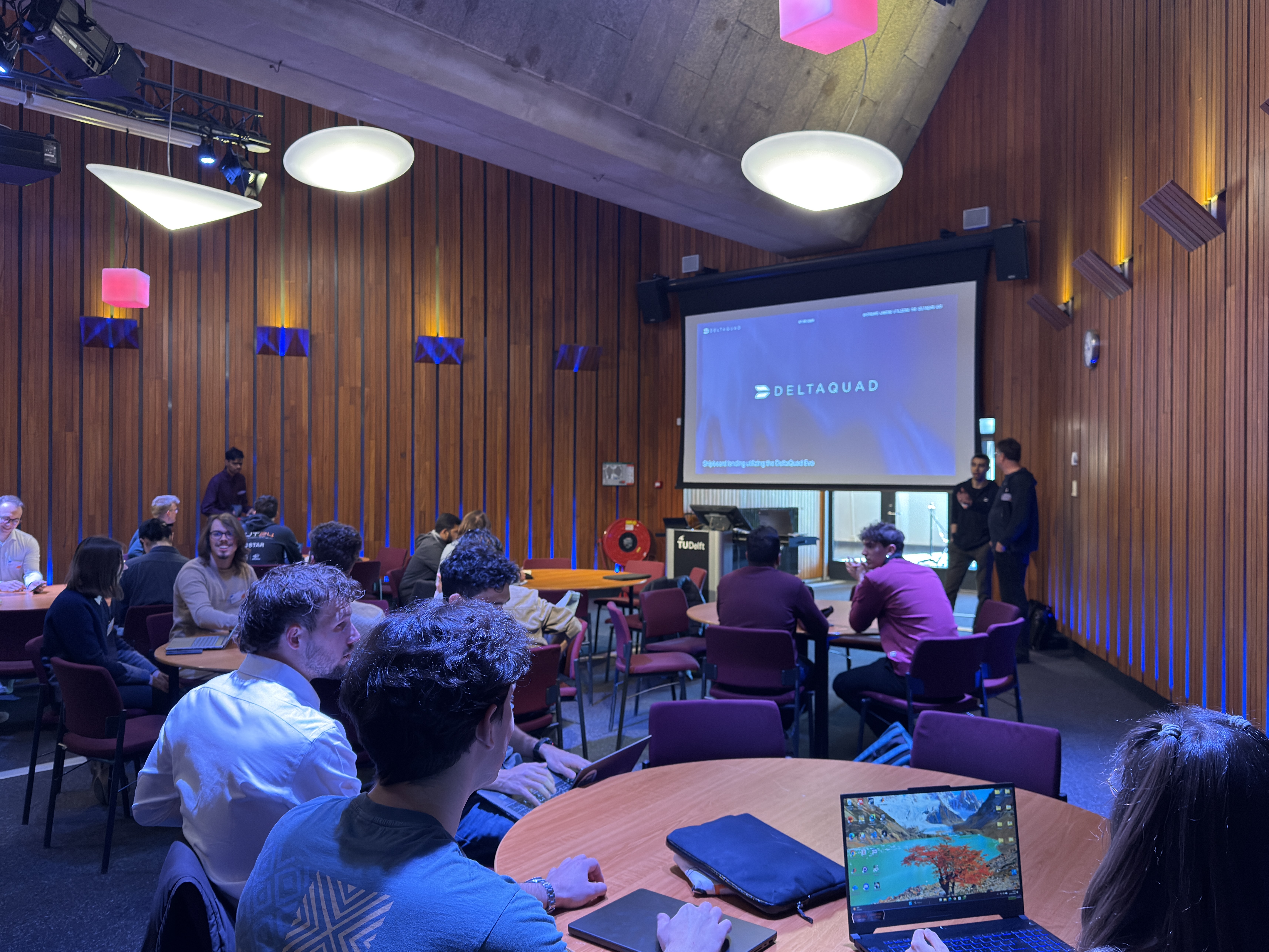
After the introduction, students were divided into groups and assigned to different parts of the challenge.
One group looked at gust rejection and wind stability. Their task was to consider how the aircraft could remain stable in high winds, especially during the transition from fixed-wing flight to multicopter mode. The students explored wind-velocity estimation, relative positioning between the drone and the ship, camera-based target locking, inertial measurements, and control strategies to improve landing reliability.
Another group focused on the vertical movement of the ship deck caused by waves. Their challenge was to determine how the drone could account for this movement during descent. The proposed approach involved keeping the drone at a reference altitude above the vessel, estimating the ship's motion and using that information to support a more controlled descent. The students explored ideas such as lidar, optical flow, IMU data, adaptive modelling and sensor fusion to improve the accuracy of the landing process.
A third group worked on trajectory planning. Their task was to determine how the drone could plan a safe path to a landing point that is itself moving. The team broke the problem down into sensing, mapping and planning. Their solution considered IMU and GPS data, cameras, fault diagnosis, no-fly zones, ship location prediction, and waypoint planning. They also showed how path-finding could be adapted to avoid unrealistic sharp turns and better reflect an aircraft’s movement constraints.
Practical systems thinking from the students
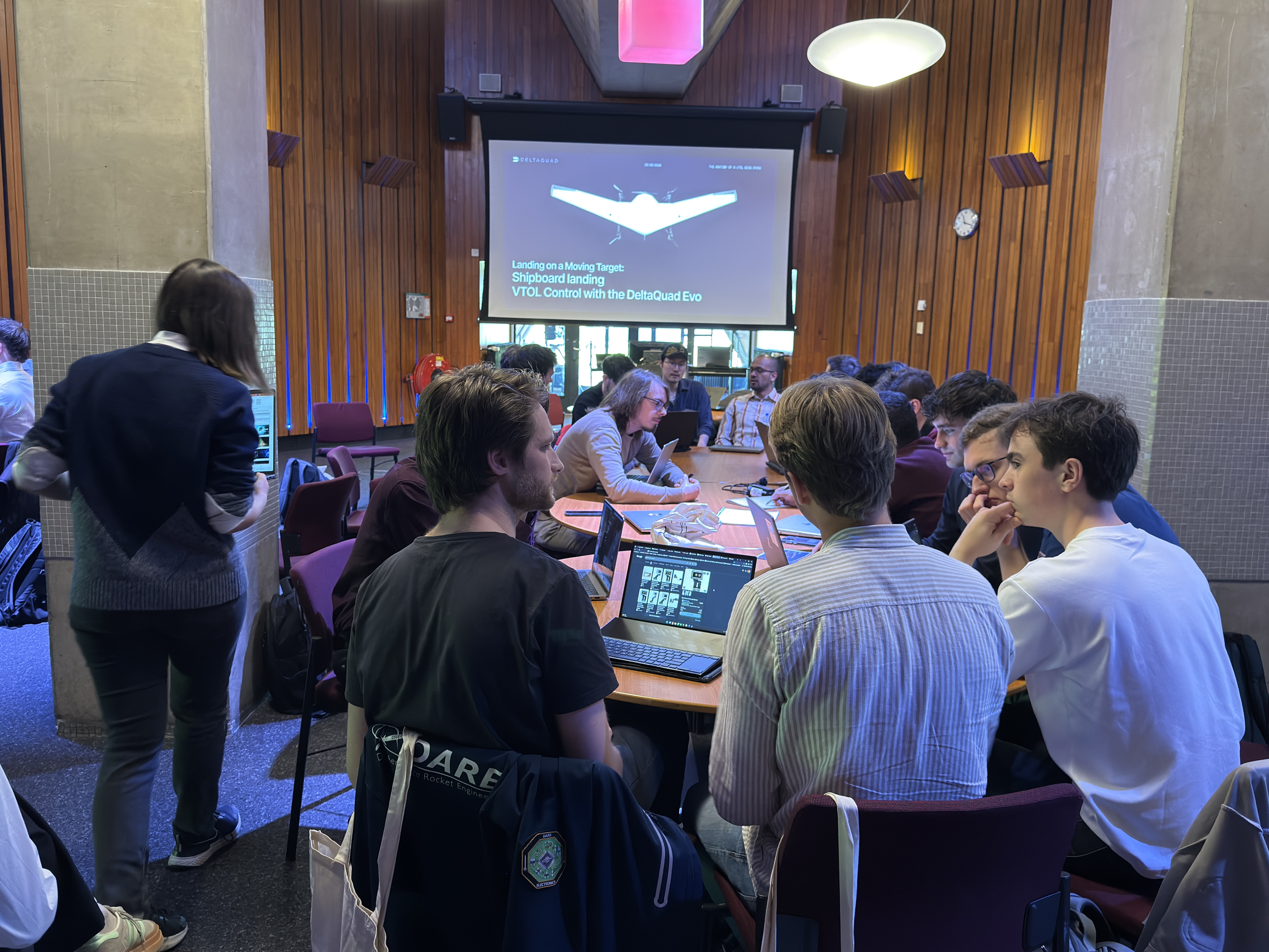
What stood out throughout the workshop was the way students approached the problem.
They were not treating shipboard landings as a clean-control problem with perfect inputs. They had to consider unreliable sensor data, environmental disturbances, moving targets, limited control authority and the need to make decisions with incomplete information.
The final presentations reflected that systems-level thinking. The proposed solutions covered several key areas:
Sensing and estimation: optical flow, lidar, IMU data and Kalman filtering
Control: model predictive control, adaptive control and gust rejection strategies
Planning: A* pathfinding, waypoint planning and ship location prediction
Safety and recovery: fault detection, no-fly zones and recovery nets
Just as importantly, the students questioned the assumptions behind their own ideas. They considered how their solutions might behave outside a controlled environment, where data may be noisy, conditions may change quickly and recovery options are limited.
Why DeltaQuad brought this challenge to TU Delft
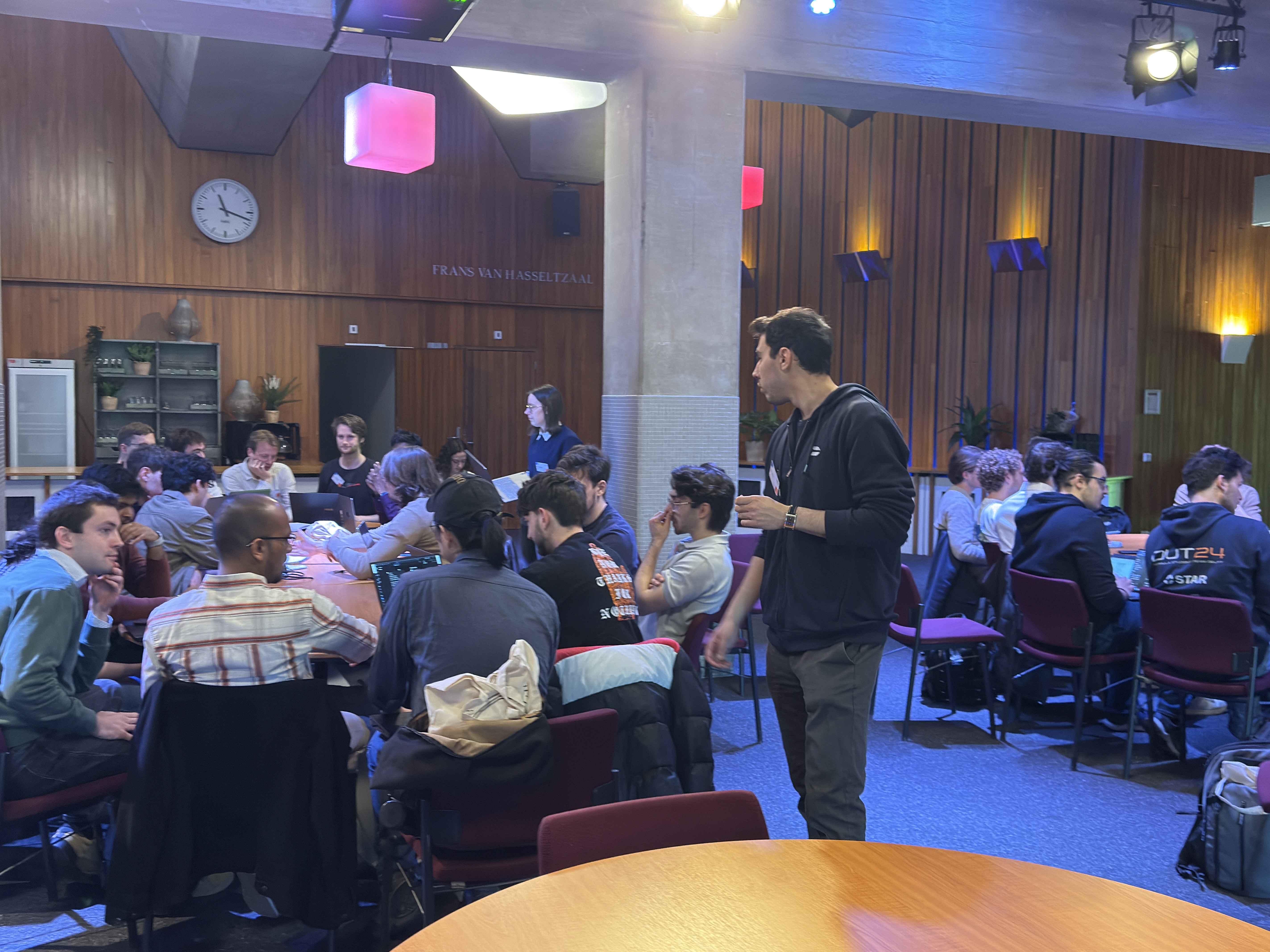
For DeltaQuad, the workshop was an opportunity to present a real engineering challenge to students interested in autonomy, aerospace, robotics and control systems.
Maritime UAV operations are demanding because they sit at the intersection of many disciplines. A reliable solution depends not only on good aircraft design, but also on sensing, control, software, planning and safety logic working together.
That is why this challenge was a strong fit for the Control & Robotics Fair. It gave students a chance to apply their technical thinking to a real-world UAV problem, while giving DeltaQuad the opportunity to connect with future engineers who are interested in building systems that operate beyond controlled lab environments.
We would like to thank TU Delft and the Control & Robotics Fair team for hosting the event, and all the students who joined the workshop with such strong technical curiosity and engagement.
At DeltaQuad, we are always excited to meet engineers who want to work on hard autonomy problems in the real world.
If you are interested in working on real-world UAV challenges, from autonomous control and flight software to aerospace engineering and mission-critical systems, explore open roles, internships and project opportunities at DeltaQuad.