Speed, Scale and Cooperation in European Defence
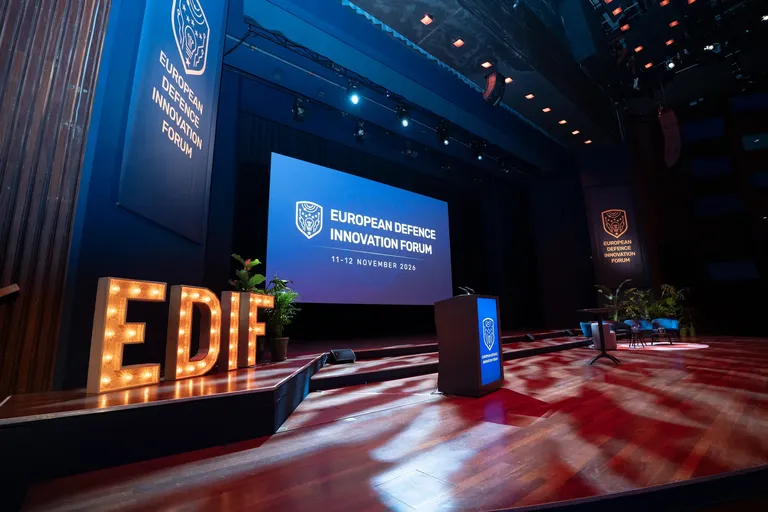
At EDIF 2026, speakers agreed that Europe must build and deploy defence capability faster. This article covers the forum's main messages and DeltaQuad's position on supply chains and open standards.
23 November 2026
A senior executive at a Ukrainian drone manufacturer told European suppliers at the European Defence Innovation Forum (EDIF 2026) in The Hague that his company asks partners to reply within 30 minutes. “Because if we answer next Monday, we will be answering about a drone that no longer exists,” he said.
That demand set the tone for the two days, focused on a shared challenge: how Europe can develop, scale and deploy defence capabilities faster, in close cooperation with Ukraine. Around 1,500 participants from over 10 countries attended, bringing together government and military representatives, manufacturers, technology developers and investors. DeltaQuad contributed to these discussions, showcasing the Evo and Evo-LE and sharing its perspective on resilient supply chains and interoperability.
An opening call to move faster
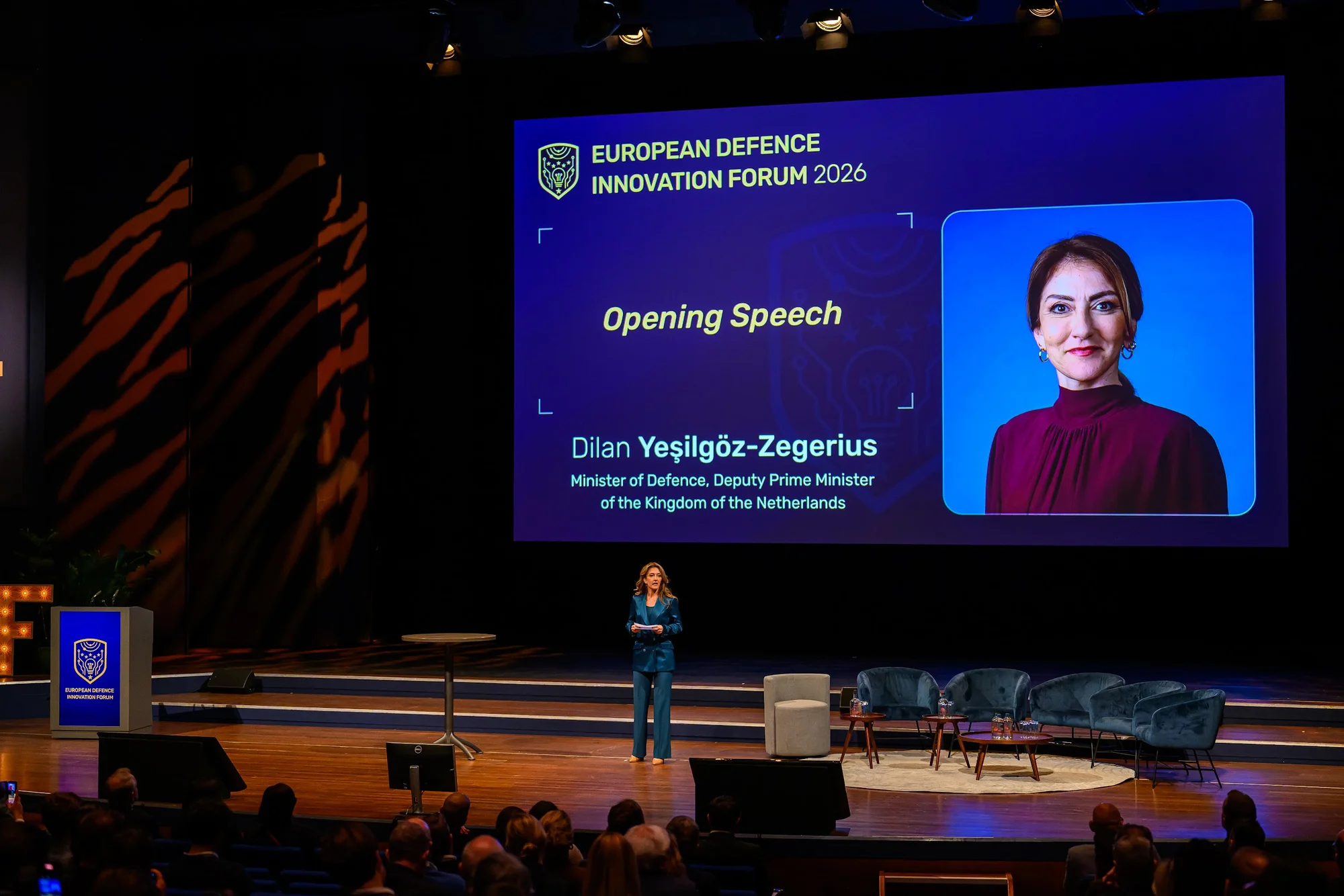 Dilan Yeşilgöz-Zegerius (Minister of Defence and Deputy Prime Minister of the Netherlands) delivers the opening speech at EDIF 2026 in The Hague.
The forum opened on 11 November with a speech by Dilan Yeşilgöz-Zegerius, the Netherlands’ Minister of Defence and Deputy Prime Minister. “Europe’s challenge is to innovate at wartime speed, without waiting for war to force us to,” she said. She added that this means cutting unnecessary bureaucracy and that “just as important is learning as much as we can from Ukraine”.
General Onno Eichelsheim, the Netherlands’ Chief of Defence, put the gap in industrial terms in his closing address on day one: “The line from factory to front line is short. The rest of Europe is not there yet. We need a bigger, faster and more integrated European defence industry.” He warned: “If we’re not able to get there, it will cost us – in more than one way.”
Learning at the speed of the battlefield
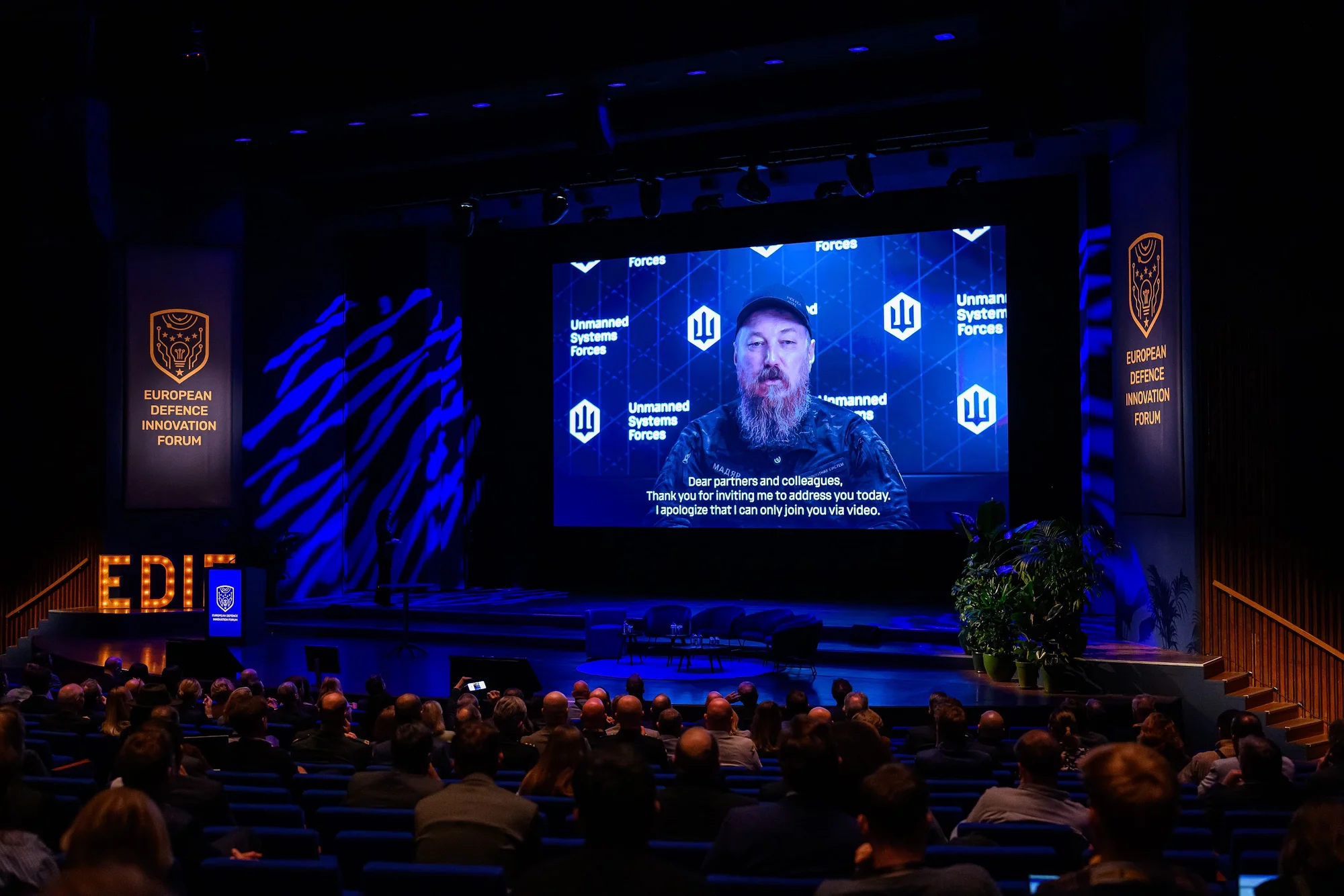 The commander of Ukraine’s Unmanned Systems Forces addresses EDIF 2026 by video.
Commander Robert “Magyar” Brovdi of Ukraine’s Unmanned Systems Forces addressed the forum by video. Modern warfare has changed the idea of a secure rear area, he said: airports, seaports, energy infrastructure and military bases can all come under threat, and those threats have moved closer to Europe.
On time, he was direct: “Do not waste time. Because in modern warfare, time is one of the most valuable resources, one that even the largest defence budget cannot buy.” He added: “Today, the weapons procurement cycle often takes longer than the cycle of technological innovation on the Ukrainian battlefield.”
The executive behind that 30-minute demand was Bohdan Diorditsa, Chief International Affairs Officer at Vyriy Industries. He presented that speed as much an opportunity as a burden. Defence technology is now one of the very few fields that can compete with AI for talent, capital and speed, he said, and he wished the reason were not the war in his country. For most businesses in the room, he argued, speed is a chance to take. He compared a late reply with the 1953 flood in the Netherlands, when a warning arrived late. His advice: “Change your pace. Synchronise it with Ukraine’s.”
The afternoon discussions on production made the same point from the supplier’s side. Designs change within weeks, so operator feedback has to reach engineering within days, and a drone needs more than an airframe: a ground station, a power source, and spare batteries are part of the capability.
DeltaQuad at EDIF 2026
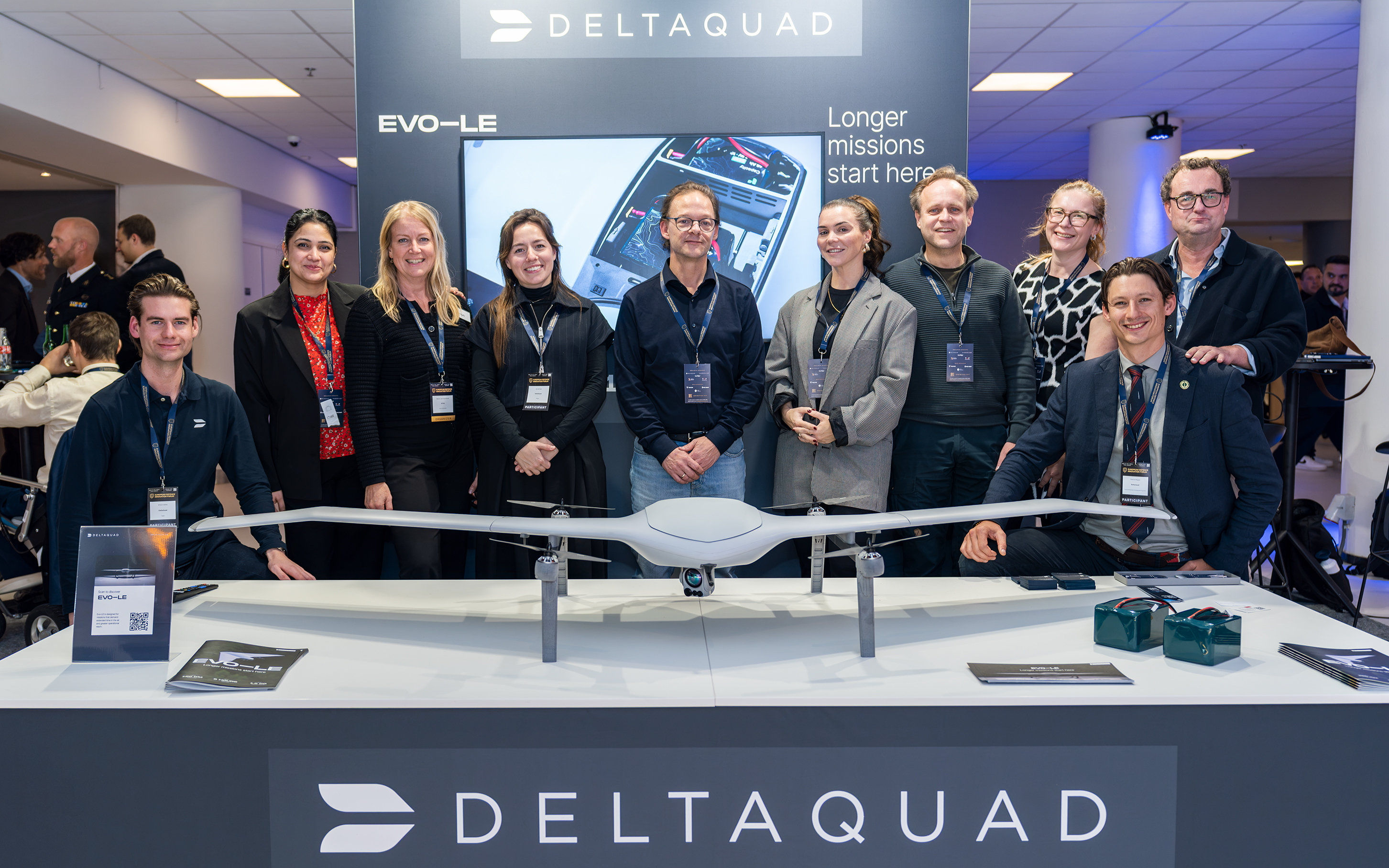 The DeltaQuad team at Booth C1 with the Evo-LE at EDIF 2026 in The Hague.
The Evo and the Evo-LE were on show at Booth C1. The Evo-LE, the long-endurance version launched in September, offers up to eight hours of flight endurance, depending on mission conditions, and was developed with input from frontline operators. On day one, DeltaQuad’s Chief Operating Officer, Marcel Woestenberg, joined the session ‘The Future of the Sky: UAV Production, Testing and Deployment’ and put the supply chain at the centre of the discussion. Europe has the assembly and operations knowledge to scale, he argued, but the harder problem is getting every part to arrive at the right moment: one supplier missing a deadline stops the line, and batteries and rare-earth materials were named as weak points. Rapid changes on the battlefield mean systems may need further adaptation by the time they are deployed, so the supply chain must absorb new iterations while staying resilient, with no single factory whose shutdown stops delivery. He also presented DeltaQuad’s aircraft as one element of a wider ecosystem: a platform with modular capabilities.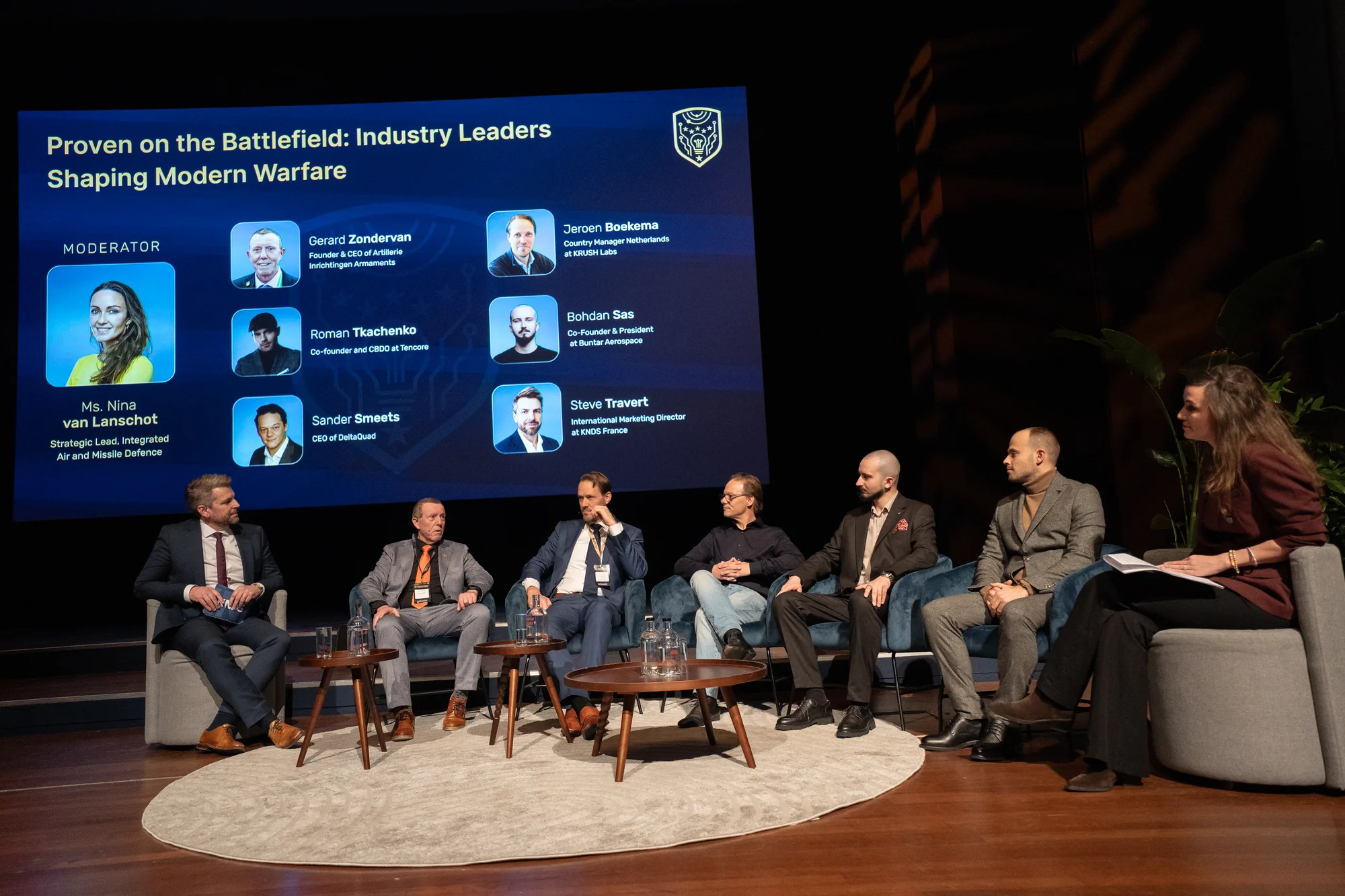 The panel “Proven on the Battlefield: Industry Leaders Shaping Modern Warfare” at EDIF 2026. Moderator: Nina van Lanschot (Strategic Lead, Integrated Air and Missile Defence, TNO). Speakers: Gerard Zondervan (Founder and CEO, Artillerie Inrichtingen Armaments), Roman Tkachenko (Co-founder and CBDO, Tencore), Sander Smeets (CEO, DeltaQuad), Jeroen Boekema (Country Manager Netherlands, KRUSH Labs), Bohdan SaS (Co-founder and President, Buntar Aerospace) and Steve Travert (International Marketing Director, KNDS France).
On day two, Sander Smeets, CEO of DeltaQuad, took a seat on the panel ‘Proven on the Battlefield: Industry Leaders Shaping Modern Warfare’. He explained how DeltaQuad came to focus on defence, starting from the company’s origins: “We started the company to make the world a better place with drones. And defence was always a small part of what we did.”
When the war in Ukraine escalated, DeltaQuad had to make a choice, and Smeets tied it to speed: "It’s the speed at which you adapt." In his words, the company chose to “stand up and defend the free world”.
Asked how unmanned systems from different manufacturers can work together, Smeets pointed to the importance of open standards and interoperability. DeltaQuad contributes to MAVLink-M within the Dronecode community, an initiative developing open communication standards to enable unmanned platforms, payloads and control systems to exchange information. He highlighted how this cooperation will become increasingly important as defence operations move toward multiple interconnected unmanned systems rather than individual platforms.
Readiness and capital
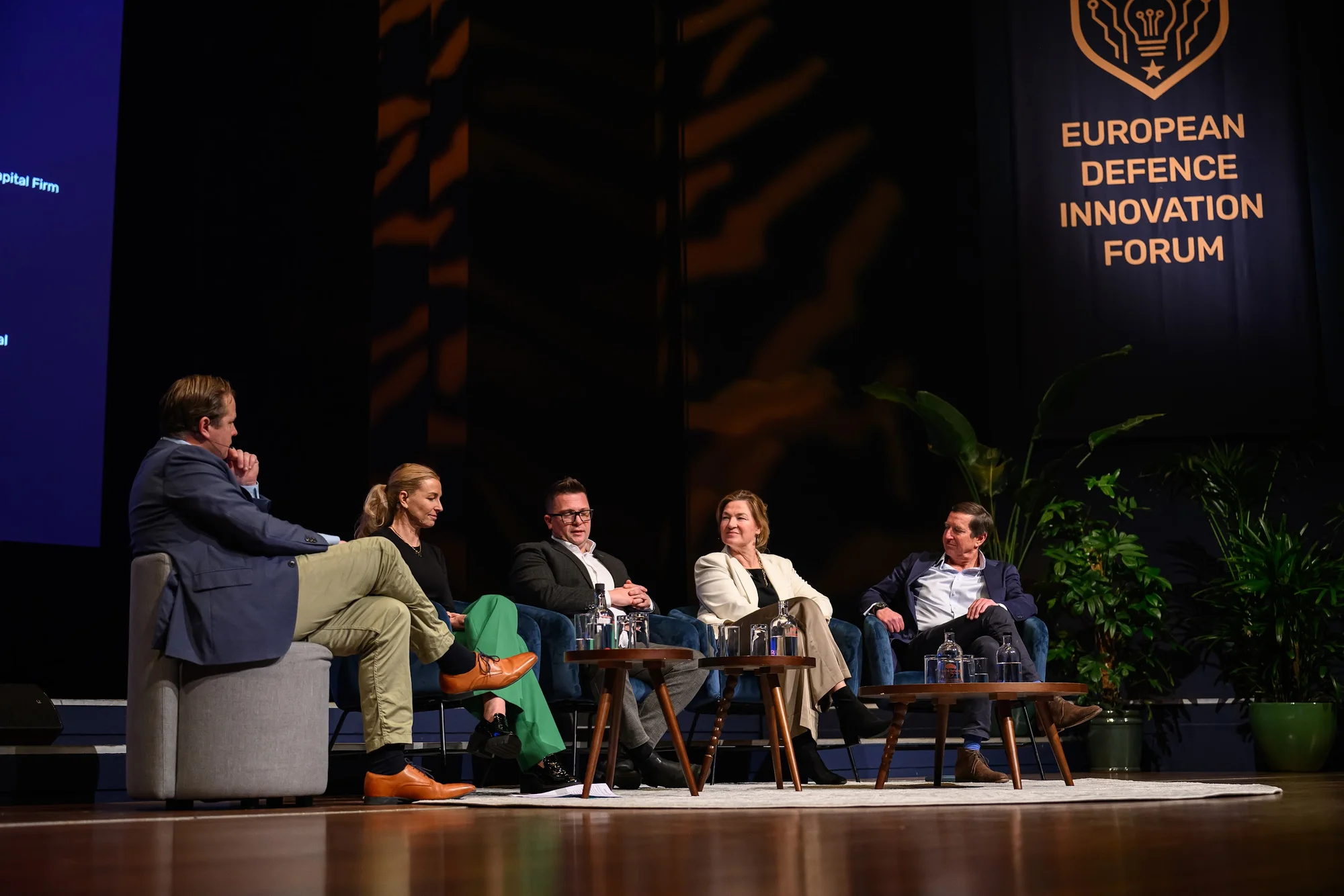 Joost Tuinman (Strategic Defence Advisor), Eveline Buchatskiy (Managing Partner at D3 Venture Capital Firm), Denys Gurak (Co-founder & COOCIO at MITS Capital), Brigit L.J.M. van Dijk – van de Reijt (CEO Brabant Development Agency)(BOM) on behalf of ROM-Nederland, Martin Davis (Managing Partner of EDT Ventures)
The Investment and Innovation Day on 12 November shifted the focus to industry and money. Maurits van Os, Head of Industrial Policy at the Dutch Ministry of Defence, said fast adaptation cycles with Ukraine are changing Dutch industry and that no nation can build a defence industrial base alone.
Oleksandr Yakovenko, Founder and Executive Chairman of TAF Industries, described readiness as a system and a team sport built on the capacity to produce, scale, and sustain advanced defence capabilities. In his words: “What really matters is how quickly we can identify a problem, test a solution, improve it and get it into the hands of the military. That speed is a defence capability in itself. The faster we can learn and adapt, the better prepared we will be for whatever comes next.”
Brigit van Dijk-van de Reijt, CEO of the Brabant Development Agency, said technology and risk capital are increasingly available, and that the constraint is how quickly technology reaches the market and is adopted by large companies and governments.
Jeroen Boekema, Country Manager Netherlands at KRUSH Labs, said on the industry panel that his company had asked the Dutch military to budget for change from the start. It calls the idea a "resilience budget": money set aside for updates and fixes in the field, because a product has to keep working long after it arrives at the front.
Human stories of defence innovation
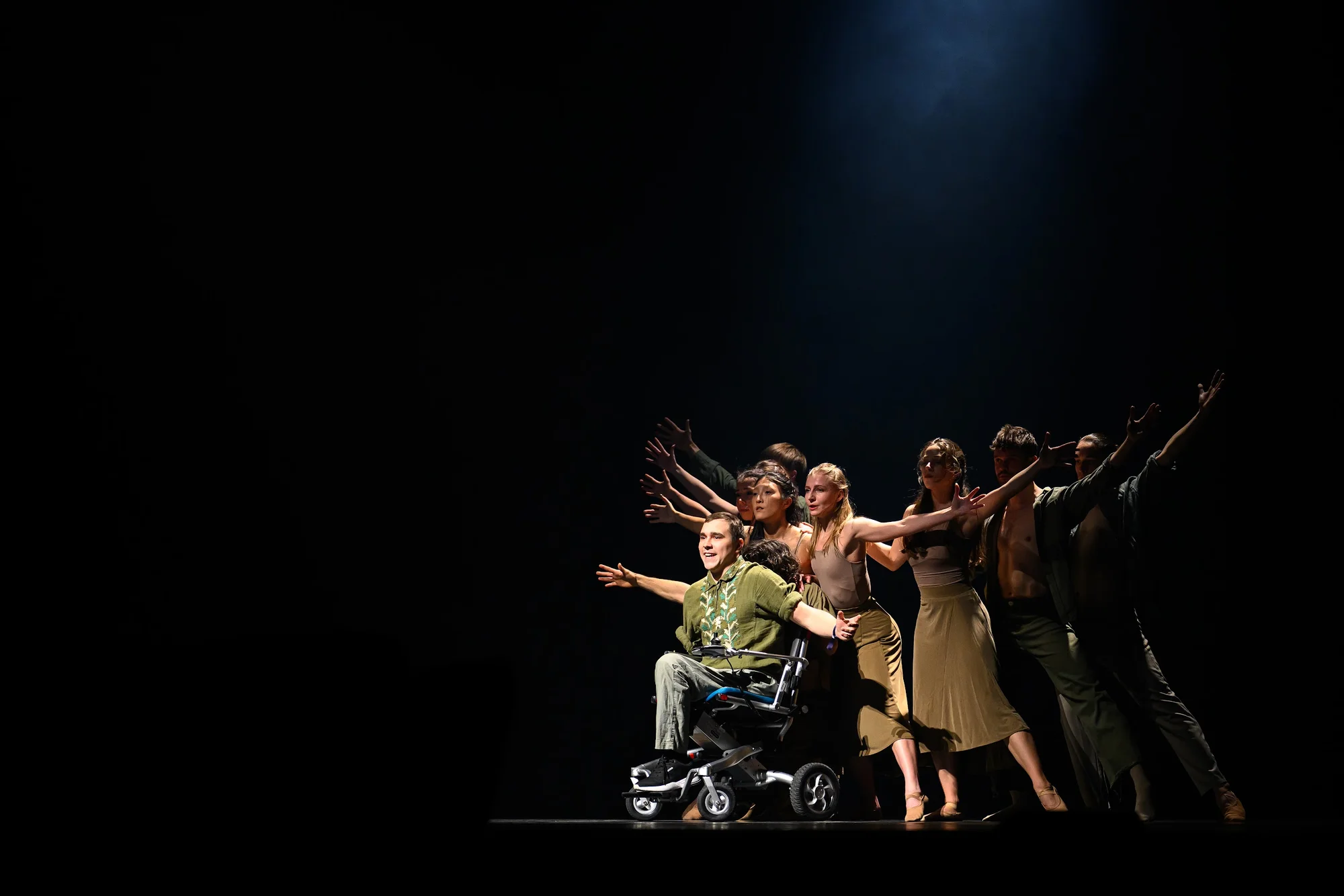 Andriy Siromakha (Ukrainian war veteran) with the Ukrainian International Ballet
The second day opened with a moving performance by the Ukrainian International Ballet. At the centre of the ensemble, a Ukrainian war veteran danced in a wheelchair while the other dancers moved in step with him.
The performance offered a powerful reminder of war’s human impact and the people behind discussions on defence innovation. The Dutch Minister of Defence gave an example of what that means in practice: drones are also “a lifeline, bringing food and ammunition to soldiers who are trapped in their positions”, and recently “a wounded soldier was even evacuated by a transport drone”. Every system on show at EDIF has to work for someone in that position, which is why speakers on both days wanted users’ feedback to reach engineers within days.
Closing the gap
Four points stood out from the two days. No solution stays effective for long, so the speed of the learning cycle is a defence capability in itself. Anyone who wants to anticipate the next threat has to stay close to the front line, which puts operators at the table early. Capability also has to be affordable and scalable, in Ukraine and across European borders. And while investment remains essential, investors highlighted that slow procurement and adoption by companies and governments can be just as significant a barrier as access to capital.
For DeltaQuad, these insights reinforce the importance of developing adaptable unmanned systems that respond to operational needs, while investing in open standards, interoperability and collaboration across the European defence ecosystem. No single company can address these challenges alone. Building effective defence capabilities requires industry, governments and end users to work together at the pace demanded by today’s operational environment.
The forum returns in 2027, and the agenda from The Hague will be its starting point.